When comparing cacao vs guarana capsules, one distinction matters immediately: coffee-free does not mean caffeine-free. Both supplements come from botanical seeds rather than coffee beans, but both plants naturally contain methylxanthines, a group of compounds that includes caffeine and theobromine.
Cacao is best known for its role in chocolate production. Guarana comes from an Amazonian climbing plant whose seeds are naturally rich in caffeine. Their botanical compounds differ, even though both products are available in convenient capsule formats.
Secrets Of The Tribe offers both Cacao Capsules and Guarana Capsules. The practical comparison should begin with plant identity, naturally occurring compounds, and verified ingredient information rather than assumptions about how either product will make someone feel.
This guide explains the differences between the two seeds, what coffee-free actually means, and which label details matter before choosing capsules for a morning routine.
- Are Cacao and Guarana Capsules Caffeine-Free?
- Cacao vs Guarana: Botanical Comparison
- What Is the Difference Between Coffee-Free and Caffeine-Free?
- Coffee-Free Products Can Still Contain Caffeine
- Why Ingredient Names Matter
- Decaffeinated Is Another Category
- What Makes Cacao Different From Guarana?
- Cacao: Theobroma cacao
- Guarana: Paullinia cupana
- What Are Methylxanthines in Cacao and Guarana?
- Caffeine
- Theobromine
- Other Botanical Compounds
- Does Guarana Contain More Caffeine Than Cacao?
- What Do the Actual Cacao and Guarana Capsule Listings Show?
- Cacao Capsules
- Guarana Capsules
- Serving Directions
- How Can You Find the Caffeine Content Per Capsule?
- Check the Supplement Facts Panel
- Review Batch Documentation
- Ask the Manufacturer
- Which Capsules Make More Sense for a Coffee-Free Morning?
- What Should You Know About Caffeine Before Choosing?
- Checklist: Choosing Coffee-Free Botanical Capsules
- 1. Confirm the Botanical Name
- 2. Identify Your Caffeine Preference
- 3. Review the Seed Preparation
- 4. Check Caffeine Information
- 5. Compare Serving Directions
- 6. Consider Other Caffeine Sources
- 7. Check Individual Suitability
- FAQ
- 1. Are cacao capsules caffeine-free?
- 2. Does guarana contain caffeine?
- 3. Is coffee-free the same as caffeine-free?
- 4. What is the main compound in cacao?
- 5. Does guarana contain theobromine?
- 6. Which seeds generally contain more caffeine?
- 7. Can you calculate caffeine content from capsule weight?
- 8. Do cacao capsules contain coffee beans?
- 9. Are coffee-free botanical capsules appropriate for everyone?
- Glossary
- Conclusion
- Sources Used
Are Cacao and Guarana Capsules Caffeine-Free?
No. Cacao and guarana naturally contain caffeine, so neither should automatically be considered caffeine-free. Their typical methylxanthine profiles are different.
Cacao seeds generally contain more theobromine than caffeine. Guarana seeds are particularly notable for their natural caffeine content.
However, the amount of caffeine in a finished capsule depends on the botanical material, processing, concentration, and serving size.
Without verified product-specific measurements, it is not possible to state exactly how many milligrams of caffeine each capsule contains.
Cacao vs Guarana: Botanical Comparison
| Characteristic | Cacao Capsules | Guarana Capsules |
|---|---|---|
| Scientific name | Theobroma cacao | Paullinia cupana |
| Plant family | Malvaceae | Sapindaceae |
| Growth habit | Tropical tree | Climbing shrub or vine |
| Native region | Central and South America | Tropical South America |
| Commonly used part | Seeds, called cacao beans | Seeds |
| Prominent methylxanthine | Theobromine | Caffeine |
| Contains caffeine naturally? | Yes | Yes |
| Contains theobromine naturally? | Yes | Yes |
| Coffee-derived? | No | No |
| Automatically caffeine-free? | No | No |
| Available product format | Capsules | Capsules |
These differences describe the plants and their typical constituents. They do not establish the exact caffeine content or comparative properties of two finished commercial supplements.
What Is the Difference Between Coffee-Free and Caffeine-Free?
Coffee-free means a product does not contain coffee ingredients. Caffeine-free means the product does not contain caffeine, or meets the applicable conditions supporting that claim. The two descriptions are not interchangeable.
Coffee-Free Products Can Still Contain Caffeine
Caffeine occurs naturally in several plants besides coffee, including tea, cacao, guarana, and yerba mate.
A capsule made from guarana seeds can therefore contain caffeine without including coffee beans.
The same distinction applies to cacao. Its association with chocolate does not mean the seeds lack caffeine.
Why Ingredient Names Matter
The scientific name helps identify the botanical source.
Cacao is Theobroma cacao, while guarana is Paullinia cupana. Neither belongs to the Coffea genus responsible for commercial coffee beans.
However, botanical identification alone cannot confirm the exact caffeine quantity in a supplement.
Decaffeinated Is Another Category
Decaffeinated products undergo processing intended to reduce caffeine content.
Even decaffeinated coffee and tea may retain some caffeine. The FDA specifically notes that decaffeinated does not necessarily mean caffeine-free.
Do not assume a cacao or guarana supplement has undergone caffeine removal unless the manufacturer explicitly confirms it.
What Makes Cacao Different From Guarana?
Cacao and guarana belong to different plant families and have different botanical histories. Both produce seeds that contain methylxanthines, but their characteristic compounds are not present in identical proportions.
Cacao: Theobroma cacao
Theobroma cacao is a tropical tree in the Malvaceae family. Its fruits contain seeds commonly called cacao beans.
These seeds are the starting material for cocoa powder, chocolate, and many other cacao products.
Cacao beans contain theobromine, caffeine, and various plant polyphenols, including flavanols.
Research on cacao composition generally identifies theobromine as its predominant methylxanthine, with caffeine occurring in smaller quantities.
The exact proportions depend on the cacao variety, growing conditions, fermentation, drying, and other processing factors.
Guarana: Paullinia cupana
Paullinia cupana belongs to the Sapindaceae family. It is native to tropical South America and is closely associated with the Amazon region.
Guarana produces fruits containing seeds traditionally processed into powders and pastes.
The seeds contain caffeine, theobromine, tannins, and other naturally occurring botanical constituents.
Guarana is particularly notable for its caffeine content. The United States Pharmacopeia identifies caffeine as a defining constituent in its official Guarana Seed monograph.
This does not mean every commercial guarana capsule contains the same amount of caffeine.
What Are Methylxanthines in Cacao and Guarana?
Methylxanthines are naturally occurring compounds that include caffeine, theobromine, and theophylline. Different botanical species contain different combinations and quantities of these substances.
Caffeine
Caffeine occurs naturally in coffee, tea, guarana, and cacao.
Its presence is relevant when comparing coffee-free supplements because avoiding coffee does not eliminate other dietary sources of caffeine.
Guarana seeds generally contain a relatively high proportion of caffeine compared with many other botanical seed materials.
Theobromine
Theobromine is another member of the methylxanthine family.
It is the predominant methylxanthine in cacao seeds and also occurs in guarana.
Theobromine and caffeine are related chemical compounds, but they are not identical. Their presence should not be used to claim that two supplements provide equivalent experiences.
Other Botanical Compounds
Cacao also contains polyphenols, including flavanols such as catechin and epicatechin.
Guarana seeds contain tannins and additional phenolic compounds.
These differences help explain why two seed-based supplements are not compositionally interchangeable.
Does Guarana Contain More Caffeine Than Cacao?
Guarana seeds generally have a higher natural caffeine concentration than cacao seeds. However, this comparison concerns botanical raw materials, not necessarily the amount delivered by a finished capsule serving.
Published research identifies caffeine as a major constituent of guarana seeds. Cacao research describes caffeine as a smaller component relative to theobromine.
Processing can change the quantities present in finished products. Botanical preparation methods and capsule fill weights also differ.
For example, a concentrated extract and powdered whole seed may contain different amounts of caffeine per gram.
Therefore, comparing caffeine exposure requires actual milligrams of caffeine per serving, not simply the names of the plants.
A claim that one finished product contains a specific amount more caffeine than another would require verified measurements from both formulas.
What Do the Actual Cacao and Guarana Capsule Listings Show?
Both products are available as capsule-based botanical supplements, including 60-count and 120-count options.
Cacao Capsules
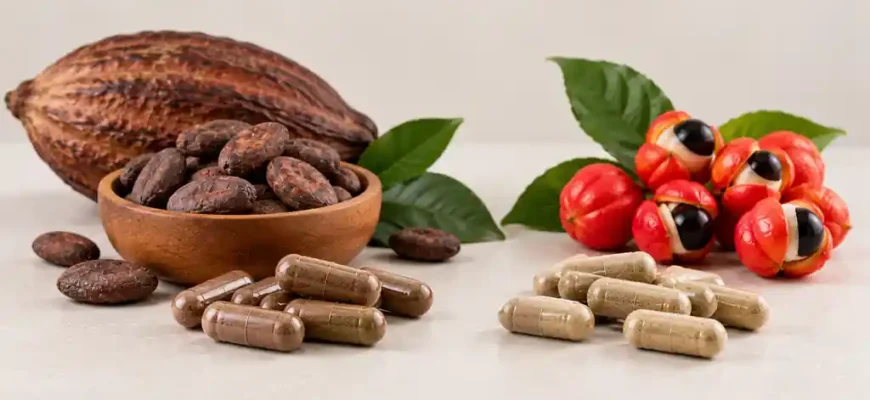
The Cacao Capsules product listing identifies organic Theobroma cacao raw beans as the botanical ingredient.
The product description highlights theobromine, flavonoids, and other naturally occurring seed constituents.
It is presented as a vegan, sugar-free capsule formula. These labeling characteristics do not establish that the product is caffeine-free.
Guarana Capsules
The Guarana Capsules listing identifies Paullinia cupana and describes caffeine, theobromine, and tannins as naturally occurring seed constituents.
The product is also offered in a vegan capsule format.
Its natural caffeine content is particularly relevant for anyone attempting to avoid all caffeine sources.
Serving Directions
Both product listings currently specify two capsules twice daily with food.
These instructions describe the manufacturer’s suggested use. They do not mean that the two products deliver equivalent quantities of caffeine or other compounds.
Follow the current label and review individual suitability before use.
How Can You Find the Caffeine Content Per Capsule?
Look for a verified caffeine quantity expressed in milligrams per serving. The botanical name alone cannot provide an accurate answer.
Check the Supplement Facts Panel
Start with the ingredient declaration and serving size.
Look for caffeine information, botanical quantities, and whether the product contains powdered seed or a concentrated extract.
If caffeine is not quantified, do not calculate an exact amount from general plant composition averages.
Review Batch Documentation
Both product listings reference a Product Passport system that allows customers to access batch-related information through a bottle’s lot number.
When reviewing laboratory reports, check whether they actually measure caffeine. A report covering identity or contaminants does not necessarily provide caffeine content.
Ask the Manufacturer
If the amount is not available, request verified caffeine information for the specific product and serving.
The most useful answer identifies milligrams of caffeine per labeled serving and, where possible, the testing method or batch information.
Which Capsules Make More Sense for a Coffee-Free Morning?
The choice depends on whether you want to avoid coffee specifically or caffeine altogether. These are different goals.
For someone interested in cacao rather than coffee ingredients, organic cacao bean capsules for a coffee-free routine offer a clearly identified Theobroma cacao preparation.
Guarana capsules provide another coffee-free botanical option, but their naturally caffeine-rich seed composition deserves particular attention.
If the goal is strict caffeine avoidance, neither product should be assumed suitable without verified caffeine information.
The editorial position at Secrets Of The Tribe is to distinguish botanical origin from caffeine content. Clear scientific names, serving information, and measurable constituent data are more useful than describing a seed-based supplement as a coffee replacement.
Capsules also differ from a morning beverage. They do not provide the preparation ritual, taste, or fluid volume associated with coffee or hot chocolate.
What Should You Know About Caffeine Before Choosing?
Caffeine exposure can come from several foods, beverages, medications, and dietary supplements consumed during the same day.
The FDA advises consumers to consider total caffeine intake and individual sensitivity. Different people may respond differently to the same quantity.
Review all sources rather than evaluating one supplement in isolation.
Possible concerns with excessive caffeine include sleep disruption, palpitations, and other unwanted reactions. These considerations are particularly relevant when using several products containing caffeine.
Anyone who is pregnant, nursing, taking medications, or managing relevant health concerns should consult a qualified healthcare professional before using these supplements.
Do not exceed labeled serving directions or combine caffeine-containing products without considering total exposure.
Checklist: Choosing Coffee-Free Botanical Capsules
A coffee-free label does not provide enough information to determine caffeine content. Use this checklist to compare botanical identity, formulation details, and serving information before adding a capsule supplement to your morning routine.
1. Confirm the Botanical Name
Check the complete scientific name on the label. This identifies the plant rather than relying on a general marketing category.
2. Identify Your Caffeine Preference
Decide whether you want to avoid coffee ingredients or caffeine itself. The distinction changes which products are appropriate to consider.
3. Review the Seed Preparation
Look for whole seed powder, raw botanical material, or concentrated extract. Preparation methods can affect constituent concentrations.
4. Check Caffeine Information
Look for verified milligrams per serving. Do not assume caffeine content based only on a botanical name.
5. Compare Serving Directions
Read the suggested amount and frequency for each product separately. Do not assume equivalent servings between different botanicals.
6. Consider Other Caffeine Sources
Review beverages, foods, and supplements already included in your routine.
7. Check Individual Suitability
Review caution statements, medications, and relevant personal circumstances before selecting a supplement.
FAQ
1. Are cacao capsules caffeine-free?
No caffeine-free conclusion should be assumed. Cacao seeds naturally contain caffeine, although theobromine is generally their predominant methylxanthine.
2. Does guarana contain caffeine?
Yes. Guarana seeds naturally contain caffeine and are recognized as a caffeine-rich botanical ingredient.
3. Is coffee-free the same as caffeine-free?
No. Coffee-free describes the absence of coffee ingredients. Caffeine can still occur naturally in other plants, including cacao and guarana.
4. What is the main compound in cacao?
Theobromine is generally the predominant methylxanthine in cacao seeds. Cacao also contains smaller amounts of caffeine.
5. Does guarana contain theobromine?
Yes. Guarana contains theobromine alongside caffeine and other botanical constituents.
6. Which seeds generally contain more caffeine?
Guarana seeds generally contain more caffeine by weight than cacao seeds. Exact capsule amounts require product-specific measurements.
7. Can you calculate caffeine content from capsule weight?
Not reliably without verified composition data. Seed variety, processing, and extract concentration can change the caffeine quantity.
8. Do cacao capsules contain coffee beans?
The listed cacao product identifies Theobroma cacao raw beans as its botanical ingredient, not coffee beans.
9. Are coffee-free botanical capsules appropriate for everyone?
No. Individual suitability depends on ingredients, caffeine exposure, medications, and other personal considerations.
Glossary
Theobroma cacao: The botanical species producing cacao seeds used in chocolate and cacao products.
Paullinia cupana: The scientific name for guarana, a tropical South American plant with naturally caffeine-rich seeds.
Methylxanthines: A family of naturally occurring compounds that includes caffeine, theobromine, and theophylline.
Caffeine: A naturally occurring methylxanthine found in coffee, tea, cacao, guarana, and other plants.
Theobromine: A methylxanthine that is particularly prominent in cacao seeds.
Flavanols: Plant polyphenols that include compounds such as catechin and epicatechin.
Coffee-Free: Describes a product without coffee ingredients, not necessarily one without caffeine.
Caffeine-Free: Describes a product without caffeine or one meeting applicable conditions for that claim.
Supplement Facts: A standardized U.S. dietary supplement label panel containing serving and dietary ingredient information.
Conclusion
Cacao and guarana capsules are botanically different coffee-free supplements, but both contain naturally occurring caffeine. Cacao is characterized by theobromine, while guarana is particularly caffeine-rich, so choosing between them requires attention to verified ingredients and caffeine content rather than assumptions about either product’s effects.
Sources Used
Cacao Capsules botanical composition, product format, and suggested use – secrets.shop / products/cacao-capsules
Guarana Capsules botanical characteristics, naturally occurring compounds, and suggested use – secrets.shop / products/guarana-capsules
Accepted botanical classification and native distribution of cacao – powo.science.kew.org / Theobroma cacao L.
Accepted botanical classification and native distribution of guarana – powo.science.kew.org / Paullinia cupana Kunth
Scientific review of theobromine and caffeine in cacao – pmc.ncbi.nlm.nih.gov / Health Benefits of Methylxanthines in Cacao and Chocolate
Scientific characterization of guarana methylxanthines and seed composition – pmc.ncbi.nlm.nih.gov / Nootropic Herbs, Shrubs, and Trees as Potential Cognitive Enhancers
Official botanical identity and caffeine specification for guarana seed – doi.usp.org / USP-NF Guarana Seed
Caffeine sources, individual sensitivity, and consumer guidance – fda.gov / Spilling the Beans: How Much Caffeine is Too Much?
Caffeine-containing botanical ingredients in dietary supplements – fda.gov / Science and Our Food Supply: Examining Dietary Supplements